
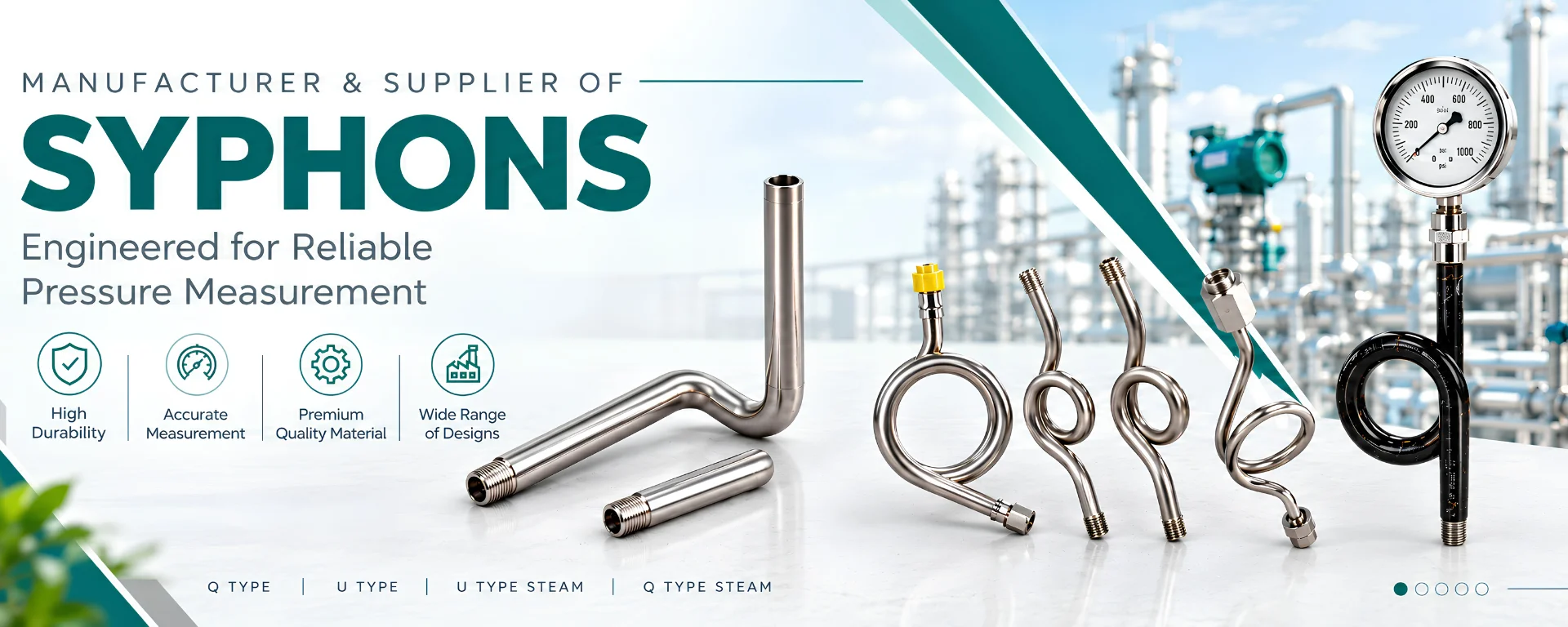
#1 Syphon Manufacturer in India
– Payal Engineering
Payal Engineering is an emerging manufacturer in the global market, engrossed in manufacturing an ISO 9001:2008 and DIN 16282 certified range of the syphon, a lifeline of pressure instruments, gauges, switches, and transmitters. The constant attempts in the quest for innovation and to introduce innovation in every piece of pressure gauge siphon to give you an unbeatable experience of safety and reliability that no other can deliver have enabled our range of pressure gauge syphon to flourish in the industries.
We have designed this siphon cautiously to meet the demand for the protection of instruments like pressure gauges, where high temperatures surrounding them can potentially cause damage or inaccurate readings due to increased temperatures. Our provided pressure gauge syphons are available in a wide variety of materials having the potential to perform excellently under corrosive environments, including stainless steel, carbon steel, brass, etc., and all are known to perform outstandingly under any media.
Special Features Of
The Syphon
- Reliable Steam Condensate Removal
- Strong and Durable Construction
- Efficient Heat Transfer Support
- Reduced Water Hammer Risk
- Low Maintenance Requirement
- Suitable for Industrial Applications
- Compact and Practical Design
- Corrosion-Resistant Options
- Consistent Performance
- Application-Specific Solutions
Other Products Of
The Syphon
Material of
Construction
Available Pressure Ranges
- Based upon 12″ Syphon
- Maximum Pressure up to 80 Bar up to 300 ˚C Maximum
- Maximum Pressure up to 100 Bar up to 120 ˚C Maximum
- Maximum Pressure up to 400 Bar up to 60 ˚C Maximum
Available Temperature Ranges
- Based upon 12″ Syphon
- Maximum Temperature up to 300 Deg C up to Maximum 80 Bar
- Maximum Temperature up to 120 Deg C up to Maximum 100 Bar
- Maximum Temperature up to 60 Deg C up to Maximum 400 Bar
Available Connection Size
- ½” NPT Male / Male Testing
- ½” BSP M ale / Male with locknut
- 3/8” NPT Male / Male
- 3/8”BSP Male / Male with locknut
OUR SPECIFICATION IS
Customization
We are in the field of manufacturing pressure gauge syphon since significant years and hence we have the prowess to understand specific requirements and accordingly deliver the solution to ensure 100% contentment. Our range of the customized pressure gauge in various dimensions, material, and capacities and conforms to DIN 16282 industrial standards.
| MATERIAL | PIPE SIZE | DI | SCHEDULE 40 | SCHEDULE 80 | SCHEDULE 160 | SCHEDULE XXS | ||||
|---|---|---|---|---|---|---|---|---|---|---|
| PLAIN x THREADED | DIAMETER | LENGTH L1 | PRESSURE Kg/cm2 | LENGTH L1 | PRESSURE Kg/cm2 | LENGTH L1 | PRESSURE Kg/cm2 | LENGTH L1 | PRESSURE Kg/cm2 | |
| A 106 Gr. B | 1/4″ | 4″ | 180 | 360 | 180 | 720 | 180 | 1080 | 180 | 1800 |
| Stainless Steel 316 | 1/4″ | 4″ | 180 | 360 | 180 | 720 | 180 | 1080 | 180 | 1800 |
| Stainless Steel 304 | 1/2″ | 6″ | 180 | 360 | 180 | 720 | 180 | 900 | 180 | 1800 |
| A 335 Gr. p 11 | 1/2″ | 6″ | 180 | 360 | 180 | 720 | 180 | 900 | 180 | 1800 |
What is a Pressure Gauge Syphon?
The pressure gauge syphon is specifically designed to protect a pressure sensor from high-temperature media, for instance, steam. Other than that, it has also proven its efficacy by reducing the damaging possibilities of the pressure gauge in rapid pressure changes. The use of the symphony with the pressure gauge permits the system builders to use pressure sensors with a considerably lower temperature range in high-temperature applications too.
During the application, the syphon should be filled with water or analogous separating medium and the concentration of the pressure medium accumulated inside the coiled portion of the syphon helps abate straight contact with the external media and hence protect the pressure sensor
WHAT ARE THE
Benefits of Our Syphon?
Gauge Whip Protection
Diminish gauge whip by removing longer pigtail, permits close coupling to the respective process.
Immediate Installation
No requirement of instruments for installation saves time
Freeze Protection
Develops a barrier to prevent freezing of instruments on wet air lines when the gauge syphon is filled with glycol. And to protect from freezing, kerosene is used.
Compact Design
Acquires less space for installation, making it ideal for areas where space is limited while ensuring efficient and convenient installation.
Steam Protection
Generates a condensate barrier between the live steam process line and the pressure measurement
WHY USE SYPHON
With PRESSURE GAUGE?
It is a well-known fact that the pressure gauge syphon is used to measure the pressure of liquid or gases in the industrial process system and therefore it is an indispensable part of the miscellaneous industries to prevent any hazard in the processing system. However, this pressure gauge gets damaged while subject to heavy loading or temperature and can permanently damage the measuring instrument.
Dynamic load cycles often result from pressure surges from a pump, which are visible on pressure gauges as pointer fluctuations. This dynamic load causes stress on the pressure element and all other mechanical components are also highly stressed due to the same, such a drastic fluctuation in the load perhaps reduces the life of the pressure gauge. This diverse impact of the load cycle needs to be addressed to increase the lifeline of the pressure gauge either by additional fittings or by equipping pressure ports during the pressure gauge syphon manufacturing. However, the extra fitting rather than the inbuilt gives a higher level of versatility and therefore it is preferable globally.
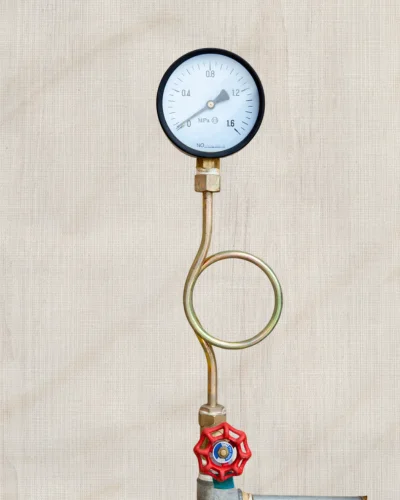
Such extra fittings are reckoned as a pressure gauge syphon in industries that not only protects pressure gauges from high pressure but also from high temperatures. Therefore, syphon or compact syphon is worth considering for protecting pressure gauge and other parallel instruments from the hot media, and vapors along with load cycles and ensuring the highest level of reliability and surety.
Pressure Gauge Syphon
Price in India
Our motive is 100% customer satisfaction that we accomplish through providing a premium quality range and delivering at the possibly lowest rate in the industry and hence we have ability to develop a considerable presence in the market and edge over competitors. The cost of the range perhaps varies as per the material, size and specification; however the final costing at which we provide pressure gauge syphon would be definitely at the lower cost than others.
Chemical Compatibility
Offered Syphon
Such extra fittings are reckoned as a pressure gauge syphon in industries that not only protects pressure gauges from high pressure but also from high temperatures. Therefore, syphon or compact syphon is worth considering for protecting pressure gauge and other parallel instruments from the hot media, and vapors along with load cycles and ensuring the highest level of reliability and surety.
| Chemical Compatibility Offered Syphon | |||
|---|---|---|---|
| Acetic Acid B | Phosphoric Acid | Ethylene Glycol | Ammonium Carbonate |
| Ethyl Acetate | Acetylene | Picric Acid | Formaldehyde |
| Oxygen | Ethylene Dibromide | Aluminum Sulfate | Potassium Cyanide |
| Acetic Anhydride | Photographic Solutions | Ferric Nitrate | Ammonium Hydroxide |
| Ethyl Cellulose | Alcohol | Picric Acid (dry) | Freon |
| Paraffin | Ethylene Dichloride | Ammonia | Potassium Permanganate |
| Acetone | Pickling Solutions | Ferric Sulfate | Ammonium Phosphate |
| Ethylene | Alums | Potassium Chloride | Gallic Acid |
| Prestone | Sea Water | Sodium Carbonate | Sodium Hydroxide |
| Beer | Benzol | Bleach Liquors | Butane |
| Gas (for lighting) | Silver Nitrate | Glycerine | Hydrogen |
| Salicylic Acid | Gasoline (refined) | Sodium Cyanide | Sodium Nitrate |
| Benzine | Benzyl Alcohol | Bordeaux Mixture | Butanol |
| Gasoline | Glucose | Hydrocyanic Acid | Hydrogen Peroxide |
| Sodium Peroxide | Butyric Acid | Sodium Phosphate | Calcium Bisulfite |
| Lacquers | Sodium Sulfate | Calcium Chloride | Lactic Acid |
| Sodium Sulfide | Calcium Hydroxide | Sodium Sulfite | Magnesium Hydroxide |
| Sulfur Dioxide | Carbon Bisulfide | Magnesium Sulfate | Carbon Dioxide(dry) |
| Sulfur Dioxide (dry) | Casein | Mercury | Sulfuric (75%) |
| Chloroform | Methyl Chloride | Sulfurous Acid | Chromic Acid |
| Methyl Salicylate | Tanning Liquors | Citric Acid | Naphtha |
| Nickel Acetate | Copper Sulfate | Nitrous Oxide | Nitric Acid |